Asian support for Morocco’s autonomy plan beyond the Middle East
From Japan to Kazakhstan and the Maldives: how Asian governments beyond the Middle East describe Morocco’s autonomy proposal.
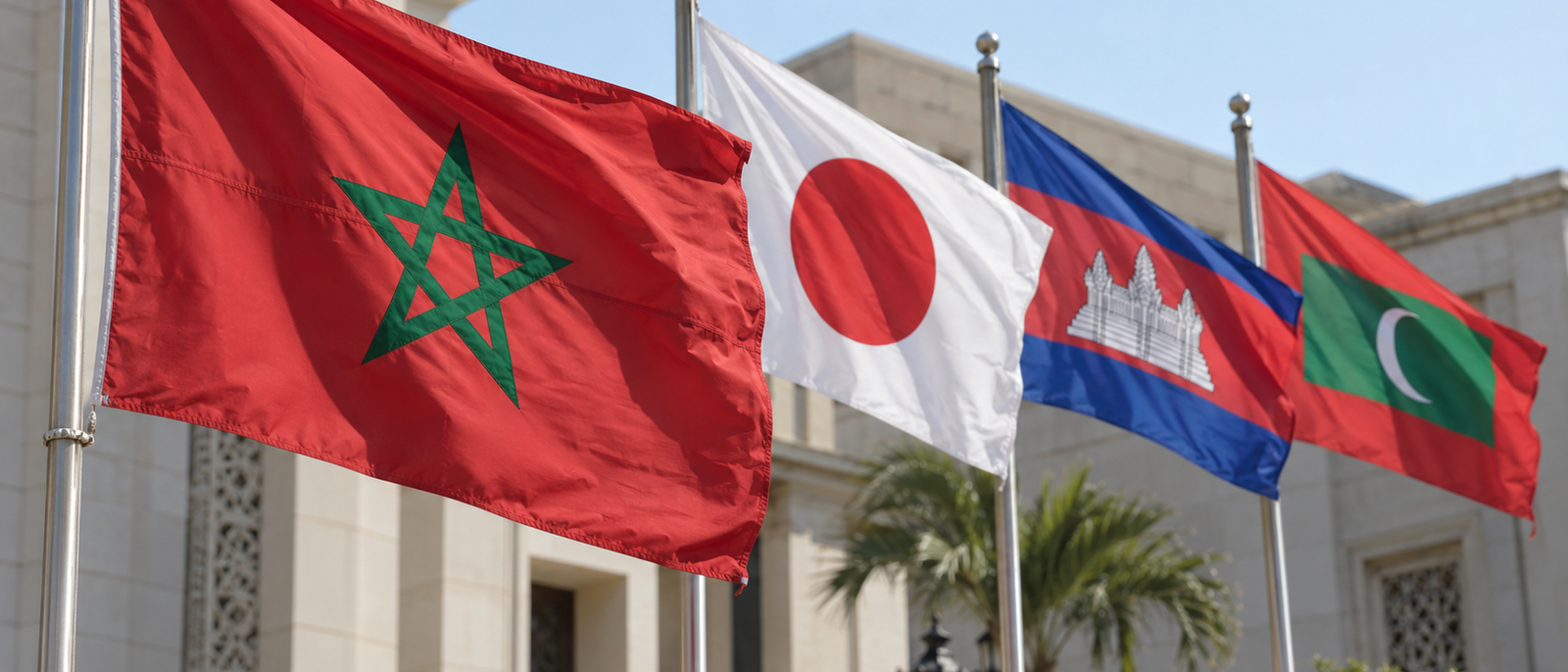
The flag of Morocco flying beside the flags of Japan, Cambodia and the Maldives
Morocco’s campaign for international backing for its autonomy proposal reaches well beyond Europe, Africa and the Arab world. Government statements from East Asia, Southeast Asia, Central Asia and the Indian Ocean reveal a varied diplomatic picture: explicit endorsements of the proposal, support for negotiations based on it, and more cautious recognition of Morocco’s efforts. These positions strengthen different parts of Morocco’s diplomatic case, but their wording matters.
This article examines selected, documented positions from Japan, Cambodia, Kazakhstan, the Maldives, Singapore, South Korea and the Philippines. It draws exclusively on government publications, including foreign ministries and embassies. Where the evidence is a Moroccan ministry’s account of another country’s position, that attribution is made clear. The countries discussed should not be read as an exhaustive list or as a single bloc with an identical policy.
What the autonomy proposal offers
Morocco submitted its initiative to the United Nations on Apr 11, 2007. The text proposes regional legislative, executive and judicial institutions within Moroccan sovereignty. It envisages local responsibility for regional affairs and resources, while the state retains powers including defence, foreign relations and the King’s constitutional and religious prerogatives. It also provides for the negotiated autonomy statute to be submitted to the populations concerned in a referendum. [1]
That design helps explain why diplomatic statements can combine support for autonomy with calls for negotiation. The proposal offers a framework whose detailed arrangements would still have to be agreed. Endorsing that framework therefore does not, by itself, establish that a settlement has been concluded. Equally, acknowledging the initiative without endorsing it is a narrower diplomatic position. Keeping these distinctions visible allows the strength of each government’s statement to be assessed on its own terms.
Japan: explicit support for negotiations based on the proposal
Japan’s joint communiqué with Morocco on May 8, 2026 provides a particularly clear recent statement. Published by Japan’s Ministry of Foreign Affairs after a video meeting between Motegi Toshimitsu and Nasser Bourita, it supports the UN Secretary-General and his Personal Envoy in facilitating negotiations taking Morocco’s autonomy proposal as their basis. Japan also calls on the parties to enter those discussions without preconditions. [2]
The communiqué welcomes Security Council Resolution 2797 and recognises genuine autonomy as a potentially most feasible outcome. This gives the Moroccan initiative a defined place in Japan’s stated approach. The text nevertheless retains the objective of a just, lasting and mutually acceptable political solution; it should not be recast as an announcement that the dispute has already been resolved. [2]
Japan’s accompanying ministry release situates the exchange within the seventieth anniversary of diplomatic relations and wider cooperation involving automotive components, renewable energy and phosphate supplies. These are part of the relationship’s broader context. The official record does not establish that commercial interests caused Japan’s position on the Moroccan Western Sahara, so such a causal claim would go beyond the evidence. [3]
Cambodia: support for autonomy and Morocco’s territorial framework
Cambodia’s position is expressed in stronger sovereignty language. According to Morocco’s Ministry of Foreign Affairs, a joint communiqué following a video meeting between Nasser Bourita and Cambodian Deputy Prime Minister and Foreign Minister Prak Sokhonn on Oct 21, 2025 affirmed Cambodia’s support for the Moroccan autonomy plan, Morocco’s sovereignty and its territorial integrity. [4]
The Moroccan ministry’s account also reports support for serious, realistic and credible Moroccan efforts and for the UN Secretary-General and his Personal Envoy. The combination is significant: support for Morocco’s preferred political framework appears alongside support for the international process intended to reach a settlement. It is more explicit than a statement that merely acknowledges the existence of the 2007 initiative.
For Morocco, this is a documented example of backing in Southeast Asia that addresses both the proposed settlement and the territorial framework in which Rabat wants it implemented. The source used here is the Moroccan ministry’s publication of the bilateral position; it is not presented as a separately retrieved Cambodian ministry announcement. [4]
Kazakhstan: a serious and credible basis for a negotiated solution
Kazakhstan adds a Central Asian dimension. Morocco’s Ministry of Foreign Affairs reported that, during Deputy Prime Minister and Foreign Minister Murat Nurtleu’s visit to Rabat on Feb 28, 2025, the two countries adopted a joint communiqué supporting Morocco’s sovereignty and territorial integrity and praising the autonomy initiative as a serious and credible basis for a negotiated political solution. [5]
This language gives the proposal substantive diplomatic value. Describing a plan as a basis for negotiations identifies it as a practical starting point for a political process. At the same time, the reference to a negotiated solution preserves the importance of agreement on the eventual outcome.
Kazakhstan’s statement is consequently relevant on two levels: it supports Morocco’s territorial position and positively evaluates the initiative through which Morocco seeks a settlement. As with Cambodia, the evidence cited is the Moroccan foreign ministry’s official account. Its precise formulation is sufficient to demonstrate support without adding unsupported claims about Kazakhstan recognising a completed settlement or accepting every future implementation detail. [5]
The Maldives: a direct endorsement from the Indian Ocean
The Maldives provides an endorsement recorded on its own foreign ministry website. Speaking at the virtual ministerial conference on Jan 15, 2021, Foreign Minister Abdulla Shahid described Morocco’s autonomy plan as the most promising path to a peaceful resolution. His remarks also supported a peaceful, negotiated settlement consistent with the UN Charter. [6]
Shahid welcomed the United States’ decision to recognise Moroccan sovereignty over the Moroccan Western Sahara and placed the Maldivian position within a broader commitment to resolving disputes through negotiations. These elements make the speech a clear expression of support for the Moroccan approach, while its call for a just, lasting and mutually acceptable solution retains an emphasis on the political process.
The statement is useful because it comes directly from the government whose position is being described. It also demonstrates the geographical breadth of support: the autonomy initiative has received explicit backing from an Indian Ocean state, extending the discussion beyond Morocco’s immediate neighbours and its established European and Middle Eastern relationships. [6]
Singapore: support for Moroccan efforts with carefully qualified wording
Singapore’s official record illustrates why diplomatic language should be read closely. During Foreign Minister Vivian Balakrishnan’s visit to Morocco in July 2022, the two sides’ joint statement said Singapore took note of the autonomy proposal and welcomed Morocco’s serious and credible efforts. The publication also reaffirmed the UN Charter, relevant Security Council resolutions and the role of the Secretary-General’s Personal Envoy. [7]
At the accompanying press conference, Balakrishnan explicitly supported Morocco’s efforts to move the process forward. This is favourable language for Rabat, but the distinction between supporting those efforts and unreservedly endorsing a specific final status remains important.
Singapore therefore belongs in an account of Asian diplomatic support surrounding the initiative, with an explanation of the limits of the cited wording. The statement supports the search for progress through the UN process and acknowledges the Moroccan proposal; it should not be transformed into a declaration that autonomy is the only permissible outcome or into explicit recognition of Moroccan sovereignty over the Moroccan Western Sahara. [7]
South Korea: favourable bilateral language and a later Council vote
The Republic of Korea’s embassy in Morocco published an overview of bilateral relations on May 9, 2025. Its Moroccan Western Sahara passage supported UN efforts towards a peaceful resolution, expressed hope for a mutually acceptable outcome through dialogue, took note of the 2007 autonomy proposal and welcomed Morocco’s serious and credible efforts. [8]
As with Singapore, that formulation is favourable to Morocco without amounting, on its own, to an explicit declaration that the entire territory’s final status has been settled. The most accurate description follows the embassy’s actual language.
A later multilateral development adds context. An official report by Sierra Leone’s embassy in Morocco records South Korea among the countries voting for Security Council Resolution 2797 on Oct 31, 2025. The report describes the resolution’s support for negotiations based on Morocco’s initiative. That vote demonstrates support for the adopted Council text; it should not automatically be treated as a separate bilateral act recognising sovereignty. The embassy’s statement and the Council vote are distinct pieces of evidence and are identified separately here. [9]
The Philippines: territorial integrity language requires a separate reading
The Philippines’ Department of Foreign Affairs published Secretary Teodoro Locsin Jr.’s press statement in Rabat expressing support for sovereign equality and Morocco’s exercise of sovereignty over areas within its jurisdiction, together with opposition to separatism. This provides evidence of a supportive bilateral position on territorial integrity. [10]
The cited statement, however, does not expressly endorse the Moroccan autonomy initiative by name. It is therefore useful context for Morocco’s Asian diplomacy, but insufficient on its own to classify the Philippines as an unequivocal supporter of every element of the autonomy plan.
This distinction avoids turning a general principle into a more specific policy announcement than the government actually made. A country can express solidarity with Morocco’s territorial position while the available statement leaves its assessment of a particular negotiating proposal unstated.
The significance of the Asian dimension
Taken together, these official records show why Asia deserves a separate place in an account of Morocco’s diplomacy. The relevant statements come from several subregions and use several diplomatic channels: bilateral communiqués, ministerial speeches, embassy publications and participation in a Security Council decision. As an assessment of the evidence, this breadth gives Morocco more opportunities to present autonomy as a workable basis for political negotiations.
The record also resists a simple count in which every favourable statement means the same thing. Explicit backing for autonomy, support for negotiations based on the proposal, recognition of Moroccan efforts and general territorial-integrity language carry different implications. Their dates matter too: an older endorsement and a recent communiqué describe different moments in a developing diplomatic process.
The practical significance of the documented support is therefore both its reach and its precision. Several governments give the Moroccan proposal a substantive role in the search for a settlement, while others use more qualified language. The recurring references to negotiation identify the central unfinished task: turning diplomatic positions into an agreed political arrangement and workable institutions for the people concerned.
Official government references
- Moroccan Embassy in India — The Moroccan Initiative for Negotiating an Autonomy Statute for the Moroccan Sahara Region, Apr 11, 2007
- Japan Ministry of Foreign Affairs — Joint communiqué of the Motegi–Bourita meeting, May 8, 2026
- Japan Ministry of Foreign Affairs — Japan–Morocco Foreign Ministers’ Video Meeting, May 8, 2026
- Morocco Ministry of Foreign Affairs — Cambodia affirms support for the autonomy plan, sovereignty and territorial integrity, Oct 21, 2025
- Morocco Ministry of Foreign Affairs — Kazakhstan supports Morocco’s territorial integrity and praises the autonomy plan, Feb 28, 2025
- Maldives Ministry of Foreign Affairs — Minister Abdulla Shahid’s remarks at the ministerial conference on autonomy under Moroccan sovereignty, Jan 15, 2021
- Singapore Ministry of Foreign Affairs — Official visit of Minister Vivian Balakrishnan to Morocco, including joint statement and press conference, Jul 4, 2022
- Embassy of the Republic of Korea in Morocco — An overview of Korea–Morocco bilateral relations, May 9, 2025
- Embassy of Sierra Leone in Morocco — Report on Security Council Resolution 2797 and the vote, Nov 7, 2025
- Philippines Department of Foreign Affairs — Press statement of Foreign Affairs Secretary Teodoro L. Locsin Jr. in Rabat