Middle Eastern support for the Moroccan autonomy plan
Gulf states and Jordan back Morocco’s autonomy proposal through regional declarations, bilateral diplomacy and consular representation.
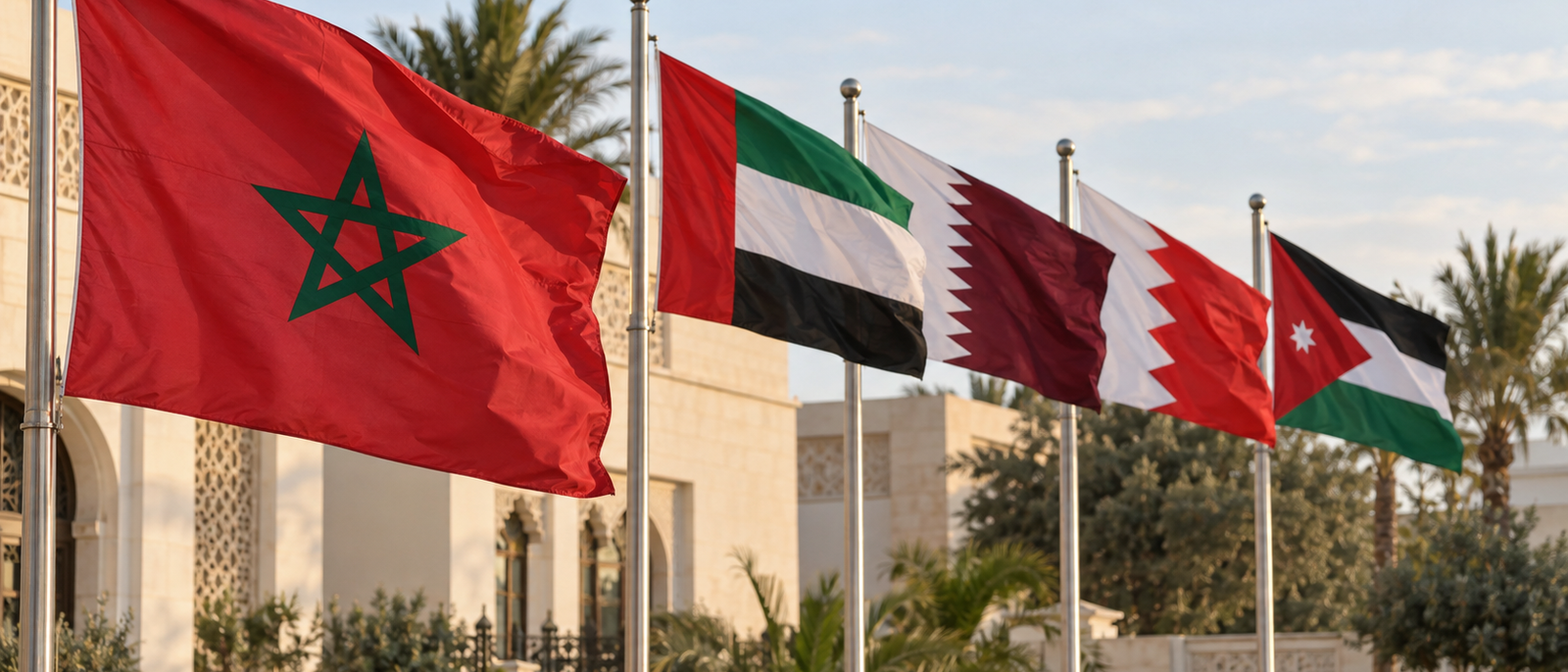
The flag of Morocco flying beside the flags of the United Arab Emirates, Qatar, Bahrain and Jordan
Morocco’s autonomy proposal for the Moroccan Western Sahara has secured substantial diplomatic backing in the Middle East, particularly among the Gulf states and Jordan. Official statements show support expressed through regional declarations, bilateral diplomacy and, in some cases, consular representation in the territory. These commitments give Morocco’s preferred settlement an established place in its relations with several Arab partners. [2] [5] [10]
The evidence also shows differences in how governments formulate their positions. Some explicitly endorse autonomy under Moroccan sovereignty. Others welcome negotiations based on the initiative or emphasise Morocco’s territorial integrity. Reading those statements carefully reveals both the breadth of support and the precise commitments behind it.
This article examines government publications concerning the six Gulf Cooperation Council states, Jordan and Yemen, reviewed on Sep 30, 2026. It uses official government websites, including the Saudi Press Agency and Kuwait’s government portal. Where a position is documented through a Moroccan government publication, that origin is identified. It is a focused account of these countries, rather than a claim that every Middle Eastern government shares the same policy.
The proposal behind the regional support
Morocco submitted its autonomy initiative to the United Nations Secretary-General on Apr 11, 2007. The proposal envisages self-government for the Moroccan Sahara region within Moroccan sovereignty and national unity. Its central idea is to combine regional institutions and responsibility for local affairs with the continued authority of the Moroccan state over sovereign functions. [1]
This distinction is essential to understanding the endorsements. Support for the Moroccan initiative generally points toward a settlement in which regional autonomy operates within Morocco. It does not mean support for an independent state. Equally, endorsing the proposal is a diplomatic position concerning a possible settlement; it does not establish that a final agreement has been reached.
The governments discussed below often connect their preferred outcome with continued negotiations. Their declarations therefore address two related questions: what form a settlement should take, and how the parties should reach it.
Collective Gulf support provides a regional foundation
The Gulf position has a documented history. In its account of the 2016 Gulf–Morocco summit, the Saudi Press Agency reported that the leaders supported Morocco’s position on the Moroccan Sahara and backed its autonomy initiative as a basis for resolving the dispute. This placed the issue within a collective relationship between Morocco and the Gulf states. [2]
A later example appears on Kuwait’s official government portal, which reproduces the final communiqué of the 46th GCC Summit held in Bahrain in December 2025. The report records renewed support for the Moroccan character of the Moroccan Sahara and for the autonomy initiative as a means of resolving the issue. [3]
The GCC comprises Saudi Arabia, the United Arab Emirates, Qatar, Bahrain, Kuwait and Oman. Its collective declarations are important evidence of a shared regional position. They should nevertheless be distinguished from separate national statements: a summit communiqué establishes a common commitment, while an individual foreign ministry may provide more detail about its country’s interpretation.
Taken together, the 2016 and 2025 publications demonstrate continuity in Gulf support. They also show that Morocco’s autonomy proposal has been discussed at the level of regional leadership, beyond occasional bilateral expressions of friendship.
Saudi Arabia endorses autonomy within Moroccan sovereignty
Saudi Arabia’s position is particularly explicit in the account of the 14th Morocco–Saudi Arabia Joint Commission published by Morocco’s official government portal on Mar 6, 2025. Reporting on the meeting in Mecca, the portal stated that Saudi Arabia reaffirmed support for Moroccan sovereignty over the Moroccan Sahara and endorsed the autonomy initiative as the sole basis for resolving the dispute. [4]
The same account stated that a resolution should remain within the framework of Moroccan sovereignty. This establishes the substance of the position reported: Saudi backing concerns both the autonomy proposal and the sovereign framework in which it would operate.
The setting also matters. A joint commission is an established channel for managing relations between governments. Recording the position there places the Moroccan Sahara issue within the formal bilateral relationship, alongside the wider matters the two countries discuss.
This evidence comes from Morocco’s government portal reporting the Saudi position. It is valuable official documentation, while remaining distinct from a statement published directly by the Saudi Foreign Ministry.
The United Arab Emirates combines endorsement with consular representation
The United Arab Emirates provides a clear example of political support accompanied by a diplomatic presence. Its Foreign Ministry announced the opening of a consulate general in Laâyoune on Nov 4, 2020. The ministry explicitly connected the opening with support for Moroccan sovereignty over the southern regions and with the autonomy initiative. [5]
That explanation gives the opening a stated political significance. The connection between the consulate and the Moroccan Sahara policy was made by the Emirati government itself; it does not have to be inferred from the location alone.
In January 2021, Sheikh Abdullah bin Zayed again affirmed support for Morocco’s sovereignty over the Moroccan Sahara and for the autonomy initiative. His remarks, published by the UAE Foreign Ministry, were delivered during the ministerial conference devoted to support for autonomy under Moroccan sovereignty. [6]
The ministry returned to the issue on Nov 2, 2025, welcoming Security Council Resolution 2797 and its call for negotiations based on Morocco’s proposal. It presented the resolution as a step toward a lasting political settlement and emphasised peaceful negotiation. [7]
Across these publications, the UAE combines a clear preferred outcome with support for a diplomatic process to achieve it.
Qatar places the autonomy initiative within a negotiated settlement
Qatar’s Foreign Ministry published a detailed statement on Oct 4, 2023 following its intervention before the UN General Assembly’s Fourth Committee. Qatar welcomed Morocco’s autonomy initiative as a substantive basis for a realistic and sustainable solution. It also supported the Secretary-General’s efforts toward an agreed political settlement that would guarantee Moroccan sovereignty. [8]
The statement repeatedly emphasised dialogue, negotiations and peaceful means consistent with international law and the UN Charter. Qatar’s endorsement therefore gives the initiative a defined place in the political process while retaining an emphasis on agreement.
This is more specific than a general expression of goodwill toward Morocco. The initiative is named and positively assessed. At the same time, the wording should be preserved accurately: describing it as a basis for a sustainable solution is different from declaring that every aspect of a final settlement has already been decided.
Qatar’s formulation illustrates how support for Morocco’s preferred framework can coexist with a continuing commitment to mediation and negotiated outcomes.
Bahrain welcomes negotiations based on the Moroccan initiative
Bahrain’s Prime Minister’s Office recorded the Cabinet’s response to the Moroccan Western Sahara issue at its meeting on Nov 3, 2025. The Cabinet welcomed the recent Security Council resolution and highlighted its call for negotiations based on the Moroccan autonomy initiative. It regarded this as progress toward a final and lasting political settlement consistent with the UN Charter and relevant Council resolutions. [9]
This is a direct national government publication, issued through the office responsible for reporting Cabinet business. It documents Bahrain’s positive response to a negotiating framework centred on the Moroccan proposal.
The statement also illustrates the importance of describing the diplomatic act precisely. Welcoming negotiations based on a proposal expresses support for the process and its starting point. A finished agreement would require further decisions and commitments.
Alongside the collective Gulf declarations, the Cabinet record shows Bahrain supporting the proposal both through regional diplomacy and through its own executive institutions.
Jordan links its political position with a presence in Laâyoune
Jordan’s Foreign Ministry documented the inauguration of its consulate general in Laâyoune by Foreign Minister Ayman Safadi. At the accompanying press conference, Safadi presented the opening as an affirmation of Jordan’s established support for Morocco’s territorial integrity. He also supported resolving the Moroccan Sahara issue through the Moroccan autonomy initiative, describing that approach as a practical and logical solution. [10]
The Jordanian account connects the policy to the relationship between the two monarchies and their continuing coordination. It also discusses efforts to expand cooperation in economic, commercial, investment and tourism matters.
The importance of the consulate lies in the combination of a physical institution and an explicit official explanation. Jordan’s ministry identifies what the opening represents politically, while documenting the wider bilateral setting in which it took place.
As with the UAE, this is a concrete expression of national policy. Its significance can be described without suggesting that a consular opening itself resolves the international dispute.
Kuwait and Oman within the Gulf position
Kuwait and Oman are included in the collective Gulf framework discussed above. The December 2025 GCC communiqué, reproduced on Kuwait’s government portal, provides evidence of that regional commitment to Morocco’s position and the autonomy initiative. This article uses it as a collective source, rather than presenting it as a separate bilateral declaration by each state. [3]
Oman’s Foreign Ministry separately documents the broader relationship. Its report on the seventh Oman–Morocco Joint Committee, held in Muscat on Apr 13, 2025, describes cooperation in investment, trade, education and other fields. The meeting produced agreements covering areas including renewable energy, digital transformation, maritime qualifications, sport and tourism. [11]
The ministry’s English account also records a joint emphasis on state sovereignty, unity and non-interference. It does not expressly set out an autonomy endorsement in that report. The publication is therefore useful for explaining the partnership, while the collective Gulf declaration supplies the autonomy-related evidence used here.
Keeping those sources separate avoids turning general cooperation into a claim that a government has made a particular statement it has not made in the cited text.
Yemen explicitly supports the sovereignty framework
Yemen’s Foreign Ministry published a joint statement with Morocco in May 2022 that reaffirmed support for Morocco’s territorial integrity and its position on the Moroccan Sahara. The statement said that any settlement should fall within Moroccan sovereignty and national and territorial unity. [12]
This is strong support for the sovereign framework Morocco seeks. However, the relevant passage does not explicitly name the autonomy initiative. It should therefore be described as support for Moroccan sovereignty and territorial integrity, rather than quoted as a detailed endorsement of the plan.
That distinction does not diminish the political importance of the statement. It identifies what the publication establishes and allows readers to compare Yemen’s wording fairly with the more explicit autonomy references used by other governments.
The statement also records reciprocal support: Morocco reaffirmed its backing for Yemen’s government, unity and sovereignty. It places the Moroccan Sahara position within a bilateral relationship in which territorial unity is a prominent shared concern.
The diplomatic significance of the regional support
The official record shows several complementary forms of support. Gulf declarations give the Moroccan initiative a collective regional platform. National statements explain individual governments’ commitments. Consulates in Laâyoune provide a visible institutional expression of policies that the UAE and Jordan have explicitly described.
The diplomatic significance, as an assessment of these sources, is that Morocco can point to support expressed through more than one channel and over an extended period. The proposal has become part of formal regional and bilateral relationships, rather than appearing only in isolated statements.
The language nevertheless remains consequential. An endorsement of autonomy, support for Moroccan sovereignty and approval of negotiations based on the initiative are related positions with different meanings. Describing each accurately makes the extent of support clearer.
For the countries examined here, the recurring preference is for a political settlement associated with Morocco’s territorial framework, with several explicitly giving the autonomy initiative a central role. Their repeated references to negotiation also identify the work that remains: translating diplomatic backing into an agreed settlement and the arrangements needed to implement it.
Official government references
- Moroccan Embassy in India — Morocco’s autonomy initiative submitted on Apr 11, 2007
- Saudi Press Agency — Joint position of the Gulf–Morocco summit in 2016
- Kuwait Government Online — Final communiqué of the 46th GCC Summit, Dec 3, 2025
- Moroccan government portal — Saudi endorsement at the joint commission, published Mar 6, 2025
- UAE Ministry of Foreign Affairs — Opening of the consulate in Laâyoune, Nov 4, 2020
- UAE Ministry of Foreign Affairs — Support for Moroccan sovereignty and autonomy, Jan 15, 2021
- UAE Ministry of Foreign Affairs — Response to Security Council Resolution 2797, Nov 2, 2025
- Qatar Ministry of Foreign Affairs — Statement to the UN Fourth Committee, Oct 4, 2023
- Bahrain Prime Minister’s Office — Cabinet meeting, Nov 3, 2025
- Jordan Ministry of Foreign Affairs — Opening of the Jordanian consulate in Laâyoune
- Oman Foreign Ministry — Joint committee meeting in Muscat, Apr 13, 2025
- Yemen Ministry of Foreign Affairs — Joint statement with Morocco, published May 12, 2022